Follow the elections: control of Congress and the races
On this page
The Elections page is the place to see what is on the ballot at the next general election. It shows the election date and the days left, who controls the Senate and the House now and what prediction markets say about who will win control, every Senate race, the governor races and the House races with the most trading, with the election news beside them.
#Open the Elections page
Choose Elections in the row of Politics sections. The title names the year of the next general election, and the first line gives its date and how many days away it is. After election day, the page moves on to the next general election.
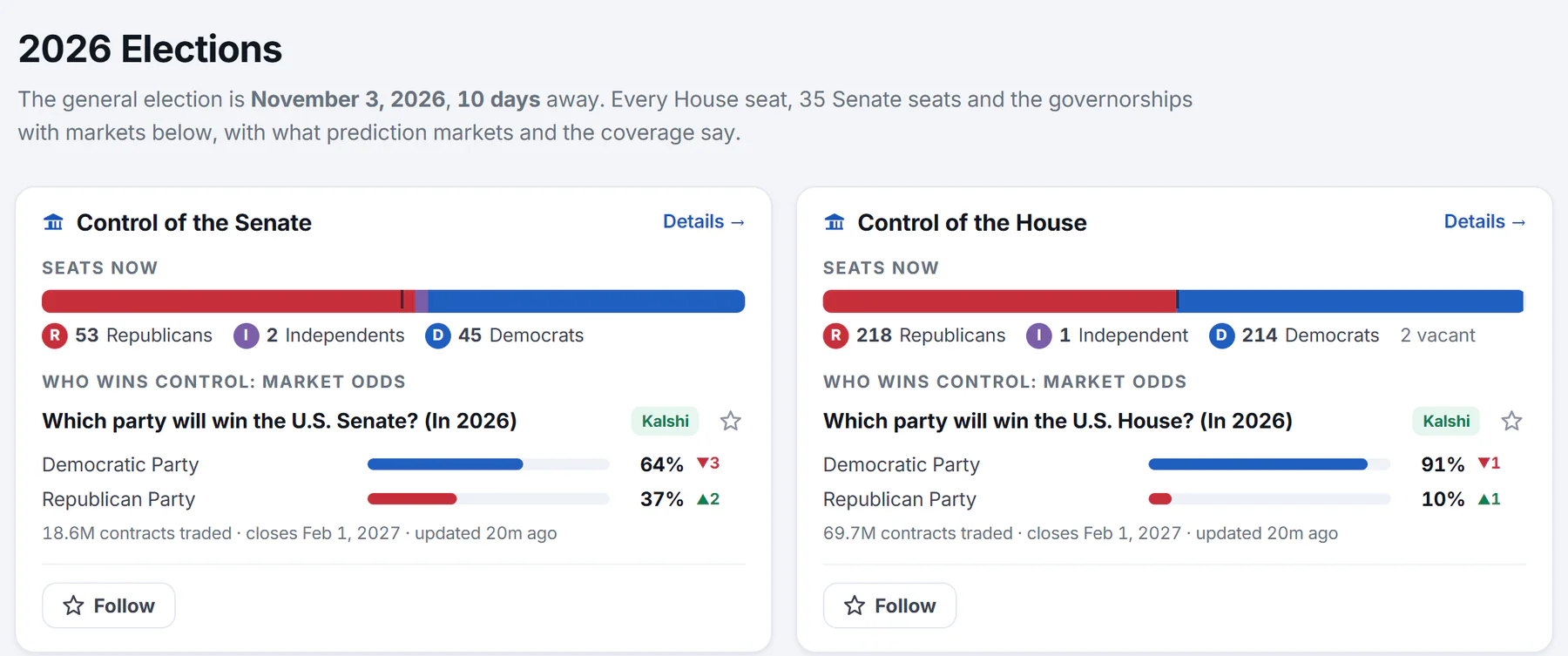
The top of the Elections page: the date and countdown, then a card for each chamber with its seats now and what a prediction market says about who wins control.
- 1Election day and the countdown
- 2Seats now, by party
- 3What a prediction market says about who wins control
- 4Details: the page for this race
- 5Follow this race
#Control of the Senate and the House
There is a card for each chamber:
- Seats now shows how many seats each party holds today, as a bar with a line marking the number needed for a majority. For the House it also notes how many seats are vacant.
- Who wins control: market odds shows the chance that prediction markets give each party of winning control, with the market's name, its source and the change over the last day.
- Details opens the page for that contest. Follow adds it to your Following page.
#Senate and governor races
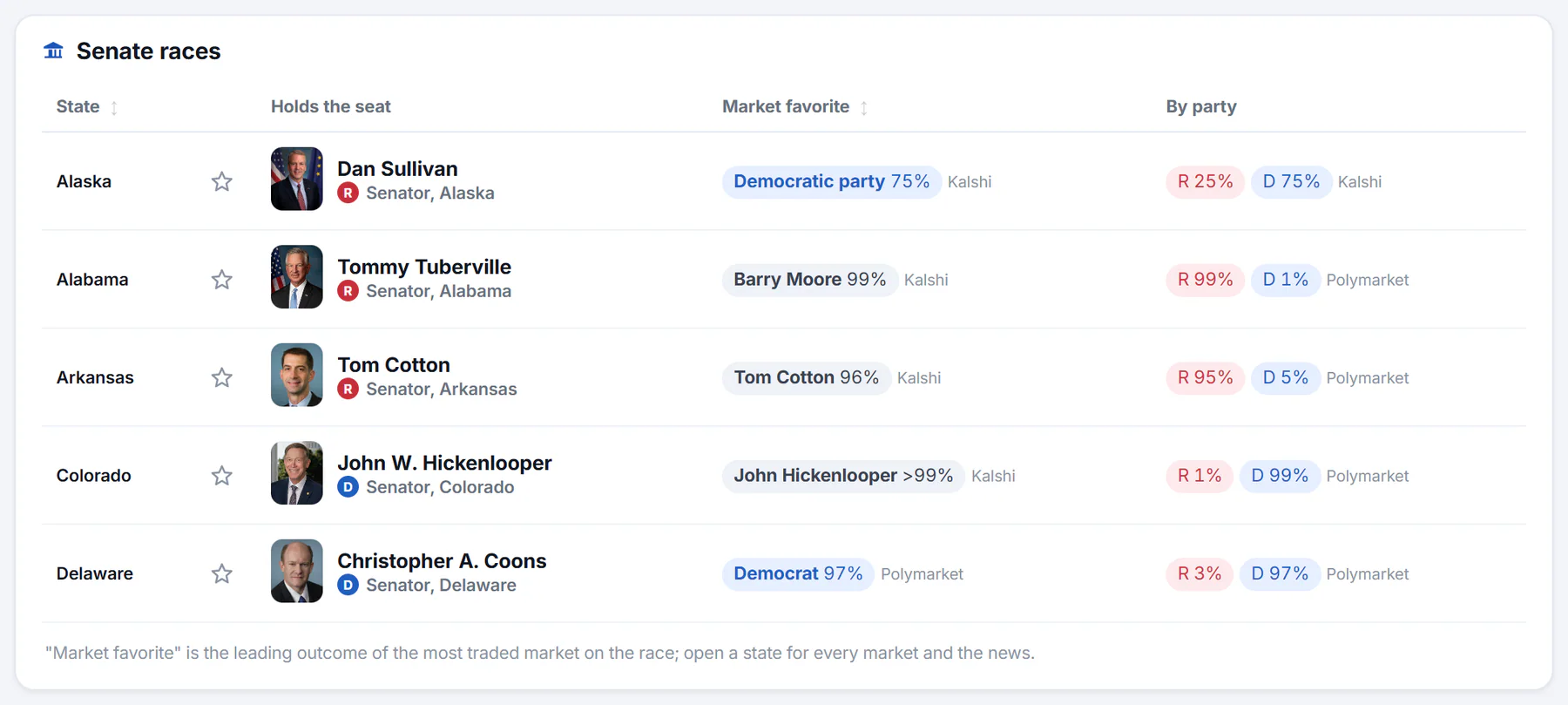
The Senate races table. One row per state; the headings tell you what each column holds.
- 1The state: select it for its race page
- 2Follow the race
- 3Who holds the seat now
- 4The market favorite, with its chance
- 5Odds by party, when the markets give them
The Senate races card has a row for each Senate seat in the election:
| Column | What it shows |
|---|---|
| State | The state's name. Select it to open the race page. The star beside it follows the race. |
| Holds the seat | The senator whose seat is up, with their photo and party. A row marked special election is a seat being filled in an election outside the regular cycle. |
| Market favorite | The leading outcome of the most traded market on the race, with its chance and its source. |
| By party | The chance each party is given, where a market gives one. |
Select the State heading to sort the table by state. Select Market favorite to sort the races by how heavily they are traded. Under the table, a note repeats what market favorite means. The Governor races card works the same way, without the column for who holds the seat.
#House races, other markets and the next presidential race
Lower on the page:
- House races with the most trading lists the districts whose markets have the most trading, with the member who holds the seat or Vacant, and the market's favorite. The note under it says how many districts have markets, and every member's page shows the market on their own seat.
- Other election markets, a card whose title carries the election year, shows markets about the election as a whole that are not tied to one race.
- Election news is the newest election headlines, with a link to the Elections topic.
- The next presidential race and Elections abroad, in the side column, show markets on the next presidential contest and on elections in other countries.
- Election topics links to the election topics, and About the odds repeats how to read the numbers.
#What the Elections page does not show
The page shows what is at stake and what markets and the news say beforehand. It does not run or publish polls, and it does not report vote counts or results. The candidate names it gives for a race come from the outcomes of its prediction markets, not from the official ballot, so a candidate may be missing or spelled the way the market spells it. For the official list of candidates and for results, use your state's election authority and the news.
#Common questions
What does "Market favorite" mean?
It is the leading outcome of the most traded market on the race, shown with the chance the market gives it. It is the market's top choice, not a forecast by 4Search and not a poll.
Why is my state's Senate race not listed?
The table lists a Senate seat when its term ends at this election, or when a market exists on a race for it. If none of your state's seats is up, there is no Senate race to show. Your state's governor race appears only when a market exists on it.
Does Politics show polls?
No. Politics does not run or publish polls. The odds on the page come from prediction markets, and the news cards show what the press published.
Where do the percentages come from?
From the markets on Kalshi and Polymarket. Each market names its source, and the page is refreshed every few minutes. The percentages are what traders are paying for each outcome, and they can be wrong.
When do the odds update?
Each market card shows when it was last updated, such as updated 8m ago.